
How Conference Interpretation Services Elevate Global Events
Imagine hosting an international conference where leaders, partners, and stakeholders from around the world come together to collaborate. The presentation begins, the ideas are strong, and the strategy is clear—yet some participants struggle to follow along due to language differences.
Even the most well-organized global event can lose momentum when communication barriers emerge. In multilingual settings, clarity is not simply helpful it is essential. When attendees fully understand what is being discussed, they can engage, contribute, and make informed decisions.
Conference interpretation services ensure that language differences do not limit participation. Instead, they create an inclusive environment where every voice can be heard and understood.
Multilingual Communication at Events: The Role of Professional Interpretation
International conferences, corporate meetings, shareholder sessions, and global summits increasingly bring together audiences that speak multiple languages. Relying on informal interpretation or automated tools may seem convenient, but complex discussions require accuracy, nuance, and cultural awareness.
Professional conference interpreters provide real-time language support that preserves meaning, tone, and context. Rather than interrupting the natural flow of conversation, interpretation services are designed to integrate seamlessly into your event structure.
When implemented thoughtfully, interpretation enhances collaboration, supports stronger engagement, and ensures that language does not become a barrier to shared goals.
What Are Conference Interpretation Services?
Conference interpretation services are specialized language solutions that facilitate spoken communication between participants who speak different languages. Unlike translation, which focuses on written documents, interpretation addresses live, spoken interaction.
Professional interpreters listen to a speaker in one language and convey the message accurately in another language. This process occurs during:
- International conferences
- Corporate board meetings
- Diplomatic summits
- Product launches
- Academic symposiums
- Government and nonprofit events
Interpreters are trained not only in language fluency but also in industry-specific terminology and professional ethics. Their role is to remain neutral, precise, and culturally sensitive while ensuring the message is conveyed clearly.
Understanding the Different Types of Conference Interpretation
Selecting the right interpretation format depends on the structure and scale of your event.
Simultaneous Interpretation
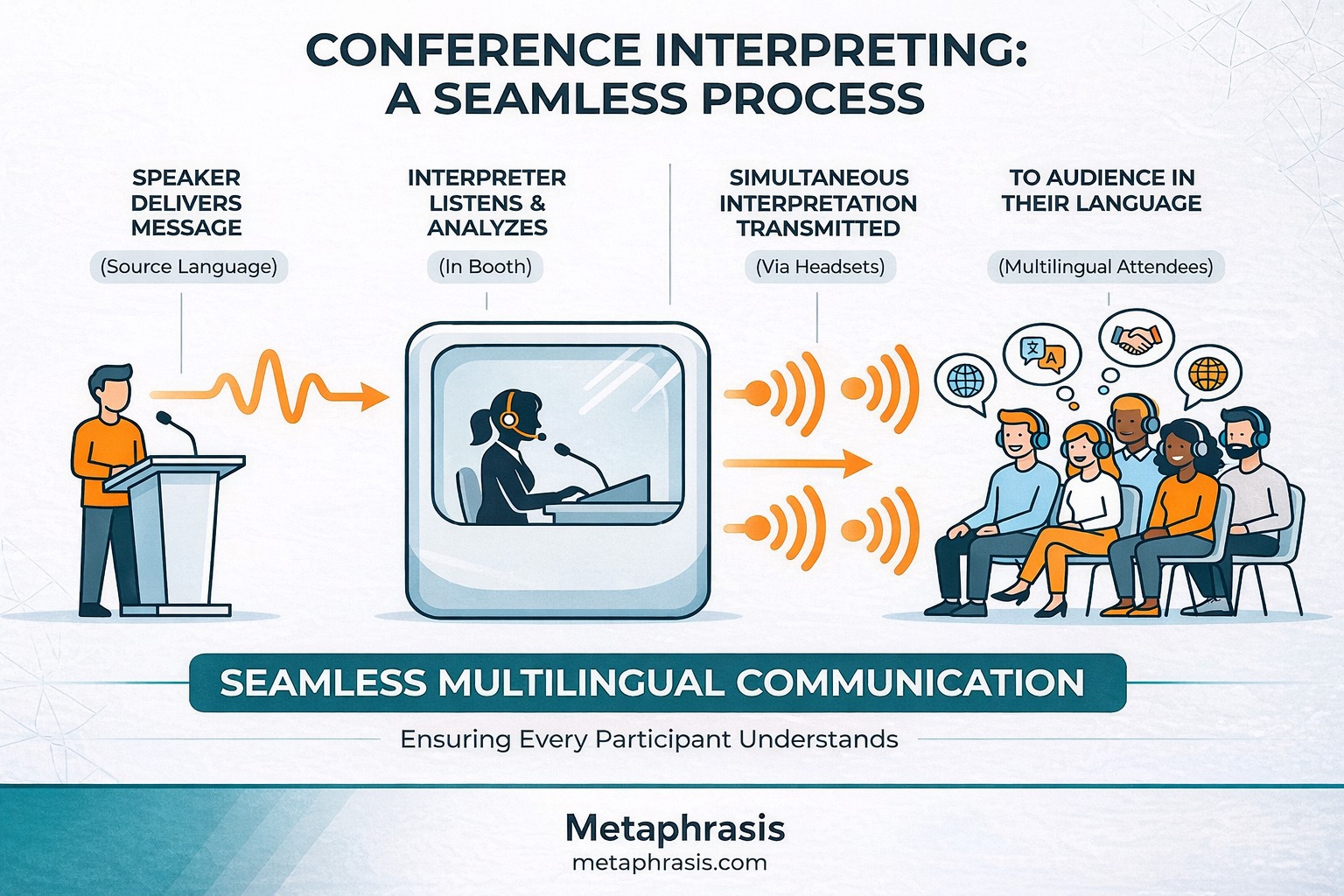
Simultaneous interpretation occurs in real time, with minimal delay. Interpreters typically work from soundproof booths, listening through headphones and speaking into microphones while the speaker continues presenting.
Attendees use wireless receivers to hear interpretation in their preferred language channel. This format is commonly used for large conferences, shareholder meetings, and international summits because it allows presentations to proceed without interruption.
Consecutive Interpretation
In consecutive interpretation, the speaker pauses periodically to allow the interpreter to convey the message in another language. This approach is well-suited for executive meetings, small negotiations, and leadership sessions where a more conversational rhythm is preferred.
Whispered Interpretation
Also known as chuchotage, whispered interpretation is used for small groups or individuals who require language support without full technical setup. The interpreter quietly conveys the message to the listener in real time.
Each format serves a specific purpose. Choosing the appropriate method ensures both efficiency and clarity.
Why Corporate and Global Events Benefit from Professional Interpretation
Global events involve careful planning, significant investment, and coordination across time zones. When participants clearly understand presentations and discussions, they are better equipped to contribute meaningfully.
Professional interpretation supports:
- Equal participation among multilingual teams
- Clear communication during negotiations
- Stronger alignment during strategic planning
- Enhanced engagement at product launches
- Inclusive shareholder and stakeholder meetings
Organizations that operate internationally recognize that nuanced communication matters. Automated tools may provide literal translations, but professional interpreters bring contextual awareness, industry knowledge, and cultural sensitivity.
For high-stakes discussions, accuracy is essential.
Why Bilingual Staff Cannot Replace Professional Interpreters
It is common for organizations to consider relying on bilingual employees for interpretation. While multilingual staff members offer valuable skills, professional interpretation requires specialized training.
Conference interpreters undergo extensive preparation and supervised practice. They are trained to:
- Process information rapidly
- Maintain neutrality
- Use industry-specific terminology accurately
- Handle high cognitive demands
- Follow confidentiality standards
Simultaneous interpretation, in particular, requires intense concentration. Interpreters often work in teams and rotate every 20–30 minutes to maintain precision.
Professional interpreters ensure that communication remains clear and consistent throughout your event.
On-Site vs. Remote Interpretation: Choosing the Right Format
Modern events may be fully in-person, fully virtual, or hybrid. Interpretation services can adapt to each format.
On-Site Interpretation
On-site interpreters are physically present at the venue. This format is ideal for:
- High-level negotiations
- Legal or diplomatic proceedings
- Technical demonstrations
- Conferences requiring physical equipment
Physical presence allows interpreters to observe body language and room dynamics, contributing to more contextual accuracy.
Remote Simultaneous Interpretation (RSI)
Remote interpretation enables interpreters to work from professional studios while participants attend virtually. This approach integrates with platforms such as Zoom, Microsoft Teams, and Webex.
RSI offers flexibility, reduced logistical complexity, and access to specialized interpreters who may not be locally available.
Many organizations combine both approaches to accommodate hybrid events.
Planning a Successful Multilingual Event Strategy
Careful planning ensures interpretation services run smoothly.
Book Early
For large conferences or peak seasons, booking 3–6 months in advance helps secure experienced interpreters with subject-matter expertise.
Provide Preparation Materials
Sharing presentations, agendas, and terminology lists at least two weeks before the event enables interpreters to prepare glossaries and research technical vocabulary.
Plan Technical Requirements
Simultaneous interpretation requires:
- Soundproof booths
- Headsets and receivers
- Audio transmitters
- Technical coordination
Advanced preparation reduces last-minute challenges and supports a seamless participant experience.
Strengthening Global Collaboration Through Language Access
Conference interpretation services do more than support a single event. They contribute to long-term global collaboration.
When multilingual teams communicate clearly:
- Decision-making improves
- Innovation accelerates
- Partnerships strengthen
- Stakeholder engagement increases
Inclusive communication fosters trust and shared understanding across cultures.
At Metaphrasis, we provide professional conference interpreters with experience across corporate, governmental, nonprofit, medical, and technical sectors. Our services include both on-site and remote interpretation, tailored to meet the needs of events of any size.
Our goal is simple: to help your global conversations unfold clearly and confidently.
Frequently Asked Questions (FAQs)
- What is the difference between conference interpretation and translation?
Conference interpretation involves real-time spoken communication during live events, while translation focuses on written documents. Interpretation requires specialized training to convey spoken messages accurately and immediately.
- When should I choose simultaneous interpretation over consecutive interpretation?
Simultaneous interpretation is best for large conferences and formal presentations where uninterrupted flow is important. Consecutive interpretation works well for smaller meetings, executive sessions, and negotiations.
- How far in advance should conference interpreters be booked?
It is recommended to book interpreters 3–6 months in advance for large events, especially during peak seasons. Early booking ensures availability and adequate preparation time.
- Can conference interpretation be provided for virtual events?
Yes. Remote simultaneous interpretation (RSI) integrates with major virtual meeting platforms, allowing multilingual participation in online or hybrid events.
- How does Metaphrasis ensure interpretation quality?
Metaphrasis works with experienced, professionally trained interpreters who specialize in specific industries. We coordinate preparation materials, provide appropriate technical setup guidance, and follow structured quality processes to ensure accuracy and professionalism.