
Scientific and Technical Translation Services for Global Research and Innovation
In an increasingly interconnected world, ideas, discoveries, and technologies rarely remain confined to one country or language. A pharmaceutical breakthrough developed in one region may save lives across continents. An engineering innovation designed locally may power industries worldwide. Yet, as knowledge travels across borders, one critical challenge remains constant: ensuring information is communicated accurately, clearly, and responsibly in every language.
This is where scientific and technical translation services play a vital role. Far more than simple language conversion, these specialized services help organizations share complex knowledge safely, compliantly, and effectively with global audiences.
At Metaphrasis, we understand that when translation involves science, technology, or regulated industries, precision is not optional—it is essential. This article explores the differences between scientific and technical translation, why they matter, and how professional expertise supports global research, innovation, and safety.
Understanding the Difference: Scientific vs. Technical Translation
Although often discussed together, scientific and technical translation serve distinct purposes. Understanding these differences helps organizations choose the right approach for their content and audience.
What Is Scientific Translation?
Scientific translation focuses on theoretical knowledge, research, and academic communication. Its primary goal is to preserve meaning, accuracy, and conceptual integrity so that research can be understood and evaluated by global scientific communities.
Scientific translation commonly includes:
- Peer-reviewed journal articles
- Clinical trial protocols and research data
- Theses and dissertations
- Research grant proposals
- Scientific textbooks and academic publications
The language used is formal, structured, and discipline-specific. Translators must understand not only terminology, but also the scientific principles and methodologies behind the text.
Scientific translation services are essential in fields such as:
- Life sciences and biotechnology
- Medicine and pharmaceuticals
- Chemistry and physics
- Environmental science
- Social and behavioral sciences
According to global research data, millions of scientific articles are published each year, often requiring multilingual dissemination. Professional scientific translation ensures discoveries can be shared responsibly, without misinterpretation or loss of meaning.
What Is Technical Translation?
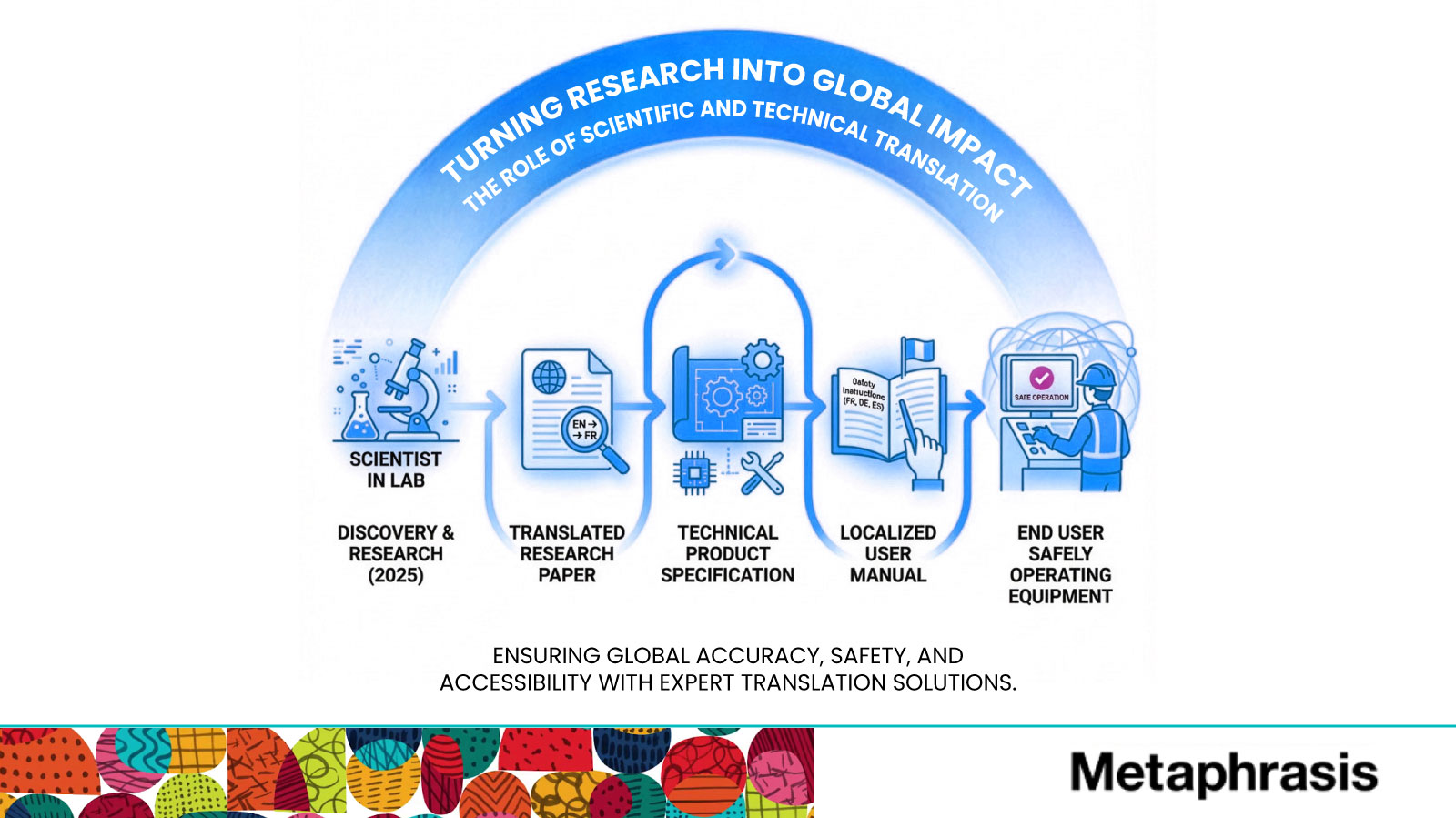
Technical translation focuses on practical application and usability. The goal is to help end users correctly and safely apply information—whether operating machinery, following procedures, or using technology.
Technical translation commonly includes:
- User manuals and instruction guides
- Product specifications and technical data sheets
- Engineering documentation and drawings
- Patents and intellectual property filings
- Software interfaces and IT documentation
- Safety documentation and MSDS
Industries that rely heavily on technical translation include manufacturing, automotive, medical devices, energy, IT, aerospace, and engineering.
For example, when technical documentation is translated for global markets, clarity and consistency become critical. A small error in a safety instruction or measurement unit can have serious consequences. Professional technical translation helps reduce these risks by ensuring accuracy, clarity, and regulatory alignment.
Difference Between Technical and Scientific Translation
While both scientific and technical translation demand specialized knowledge and linguistic precision, their distinct objectives lead to different approaches and priorities. Here’s a quick comparison to highlight these differences:
| Feature | Scientific Translation | Technical Translation |
|---|---|---|
| Primary Goal | Disseminate theoretical knowledge and research findings | Facilitate practical application, operation, and understanding |
| Target Audience | Academics, researchers, scientists, students | Engineers, technicians, consumers, operators, end-users |
| Common Document Types | Research papers, journal articles, theses, clinical trials, academic textbooks | User manuals, patents, data sheets, product specifications, engineering drawings, technical reports |
| Key Metric | Conceptual accuracy, scientific terminology, academic tone | Clarity, conciseness, usability, practical applicability, safety |
Where Scientific and Technical Translation Overlap
In many modern industries, the line between scientific and technical translation is not always clear. Fields such as biotechnology, medical devices, and advanced engineering often combine research-based content with practical application.
In these cases, professional translation services adapt their approach based on:
- The document’s purpose
- The intended audience
- Regulatory and compliance requirements
At Metaphrasis, we carefully assess each project to ensure the translation strategy aligns with both the content and its real-world use.
Key Challenges in Scientific and Technical Translation
-
Managing Complex and Specialized Terminology
Scientific and technical content contains terminology that is highly specialized and often evolves rapidly. Many terms have no direct equivalents across languages, while others may carry different meanings depending on context.
Professional translation services address this challenge by:
- Developing industry-specific glossaries
- Maintaining terminology consistency across documents
- Researching emerging terminology in evolving fields
- Ensuring alignment with international standards
Unlike general content, variety in wording is not desirable in technical or scientific translation. Precision and consistency are critical to maintaining clarity and credibility.
-
Ensuring Accuracy in High-Stakes Content
In scientific and technical fields, translation errors can have real-world consequences. Misinterpretation may lead to:
- Regulatory delays or rejections
- Safety risks or equipment malfunction
- Legal disputes or compliance issues
- Misuse of products or processes
Professional translation services apply strict quality control processes to minimize these risks. Numbers, measurements, tables, charts, and units of measurement receive the same attention as text, ensuring full accuracy and consistency.
-
Requiring Subject Matter Expertise
Language fluency alone is not sufficient for scientific or technical translation. Translators must also understand the subject matter deeply.
Qualified translators often have:
- Academic degrees in scientific or technical fields
- Industry-specific professional experience
- Native-level language proficiency
- Ongoing training to stay current with industry developments
At Metaphrasis, translators are carefully selected based on both linguistic skills and domain expertise. This dual competence ensures translations accurately reflect both meaning and technical intent.

The Role of Technology in Professional Translation
Translation Technology as a Support Tool
Modern translation services use advanced technology to enhance consistency and efficiency while keeping human expertise at the center.
Key tools include:
- Computer-Assisted Translation (CAT) tools to manage large projects and ensure consistency
- Translation Memory (TM) systems that store previously approved translations
- Terminology databases customized to each client and industry
These tools help maintain consistency across multilingual documentation and improve turnaround times without compromising quality.
Quality Assurance: The TEP Process
Professional translation services follow structured quality assurance processes. One widely accepted model is the TEP process:
- Translation by a subject matter expert
- Editing by a second qualified linguist
- Proofreading to ensure accuracy, formatting, and readability
This layered approach ensures each document meets high professional and industry standards before delivery.
Why Professional Translation Matters for Global Growth
Scientific and technical translation supports more than communication—it enables collaboration, compliance, and trust.
Organizations benefit by:
- Sharing research globally without misinterpretation
- Ensuring products are used safely and correctly
- Meeting regulatory requirements in multiple regions
- Strengthening credibility with international stakeholders
For companies operating across borders, professional translation becomes an essential part of risk management and global strategy.
Why Choose Metaphrasis for Scientific and Technical Translation?
At Metaphrasis, we approach scientific and technical translation with care, precision, and respect for the responsibility it carries.
Our services are built on:
- Native-speaking translators with domain expertise
- Industry-aligned terminology management
- Rigorous quality assurance processes
- Cultural and regulatory awareness
- Clear communication and dependable timelines
We recognize that behind every document is a real-world application—whether advancing research, protecting safety, or enabling innovation.
Frequently Asked Questions (FAQs)
- Which industries benefit most from scientific and technical translation services?
Industries such as pharmaceuticals, life sciences, medical devices, engineering, manufacturing, IT, energy, aerospace, and environmental science rely heavily on specialized translation for global operations.
- Why are scientific and technical translations more specialized than general translations?
These translations require subject matter expertise, strict terminology consistency, and deep understanding of industry standards. Accuracy is critical because errors may affect safety, compliance, or research integrity.
- Can machine translation be used for technical or scientific documents?
Machine translation may assist with low-risk or internal content, but it cannot replace professional human translators for high-stakes documents where accuracy, context, and regulatory compliance are essential.
- How does Metaphrasis ensure translation quality?
Metaphrasis uses experienced subject matter experts, terminology management tools, and a structured translation–editing–proofreading process to ensure accuracy and consistency.
- Are professional translations accepted by regulatory authorities?
Yes. Professionally translated documents, when prepared according to industry and regulatory standards, are widely accepted by government bodies, courts, universities, and international organizations.
Supporting Global Innovation Through Accurate Communication
Scientific discoveries and technical innovations have the power to improve lives worldwide—but only when they are communicated clearly and accurately. Professional scientific and technical translation services help bridge language gaps while preserving meaning, safety, and intent.
At Metaphrasis, we are committed to supporting global research, innovation, and collaboration through precise, culturally aware, and professionally managed translation services.
When accuracy matters, thoughtful translation makes all the difference.